
They Are Necromancing the Left
How the far right revives dead revolutions to serve power

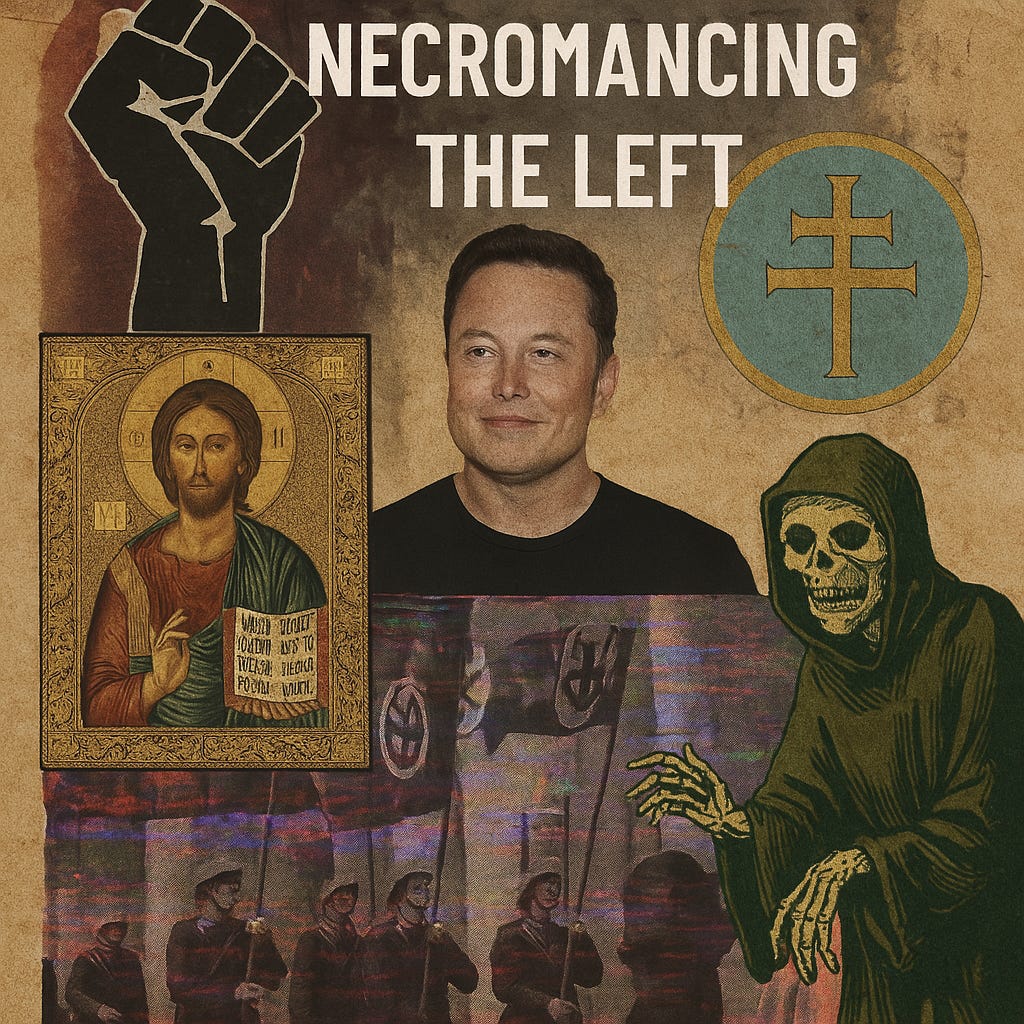
Punk, mysticism, gender performance, even anti-capitalism—nothing is safe. When resistance is stripped of history and turned into performance, what’s resurrected isn’t liberation. It’s control.
The Sound of the Undead
Why does far-right music sound so bad—not morally, but musically? Not just fashwave or white power punk, but the whole aesthetic universe of the reactionary remix. Even when it’s well-produced, something always feels hollow, like a parody of rebellion.
It’s because it’s always a step behind. Behind innovation. Behind culture. Behind rupture.
Far-right music copies what has already been invented—most often by movements of resistance, by the left, by the margins. It doesn’t birth its own sound; it hijacks. It’s not a pulse—it’s a seance.
The right isn’t just copying aesthetics. It’s reclaiming and reanimating leftist concepts, tools, and narratives. It’s necromancing the left.
Necromancy Defined
Necromancy—originally the ritual of summoning the dead for knowledge or power—becomes in this context a metaphor for ideological theft. The far right raises the ghosts of emancipatory struggles and turns them into instruments of domination. They perform the language of freedom, dress like rebels, even sound like resistance. But their rituals end in power, not justice.
From Self-Help to Sovereignty: The Romanian Case
Călin Georgescu is a good necromancer. But not of communism—of its afterglow. He doesn’t call for collective ownership or workers' power. He resurrects the material memory of communism’s industrial legacy, its independence from global capital, its sense of self-determination—but rips it from its political root. What’s left is a nationalist shell, a mystic vision of “Romania for Romanians,” driven by private property and Orthodox destiny.
In Eastern Europe, 'communism' isn’t just a defeated ideology—it’s the enemy in every myth, the justification for every betrayal, the stand-in for every unresolved trauma. That’s why the far right thrives here: the battle isn’t just against fascism—it’s against the very memory of the left.
This Is Not Just Romania
This is global. Liberalism has always preferred fascism to communism when push comes to shove. The CIA collaborated with Klaus Barbie—the “Butcher of Lyon”—to hunt and kill Che Guevara. It backed coups in Chile, Guatemala, Brazil—wherever leftist parties won elections. Even the 1956 Hungarian uprising now shows traces of CIA involvement, as Trump-era declassified files reveal.
The anti-communist propaganda machine wasn’t just Cold War paranoia. It was foundational to the Western order. That’s why today, mainstream parties absorb far-right rhetoric instead of challenging it. Because they aren’t interested in dismantling hierarchy—they just want to manage it.
Interlude: John Dee, the Empire’s Necromancer
Before we think of fashwave or nationalist techno, there was John Dee—mathematician, alchemist, astrologer, and advisor to Queen Elizabeth I.
Dee wasn’t just a scholar; he was a necromancer of empire. With the help of medium Edward Kelley, he communicated with angels and the dead, claiming divine messages in a new “Enochian” language. He sought hidden truths and occult geometries—but always in service of a greater mission: to expand and sanctify British imperial power.
He stands at the threshold: both edge-walker and state servant. His visions fueled a world-shaping violence. And yet, he also pushed against religious orthodoxy, against the limits of sanctioned knowledge.
Dee shows us that necromancy has always been a double-edged tool: it can unsettle power—but it can also justify it in mystical terms.
The far right today isn’t unlike Dee. They conjure the dead: ancient glories, lost orders, golden ages. But they do it not to liberate, but to command.
“Fascism aestheticized politics.” (Walter Benjamin)
The far right isn’t winning because it’s strong. It’s winning because it knows how to wear our skin. What we called the center was never neutral—it was always a threshold.
And we can’t afford to be polite at the gates of necromancers.
Bibliography & Further Reading
Benjamin, Walter. 'The Work of Art in the Age of Mechanical Reproduction.' (1935).
Eco, Umberto. 'Ur-Fascism.' The New York Review of Books, 1995.
Fisher, Mark. 'Capitalist Realism: Is There No Alternative?' Zero Books, 2009.
Traverso, Enzo. 'The New Faces of Fascism: Populism and the Far Right.' Verso, 2019.
Federici, Silvia. 'Witches, Witch-Hunting, and Women.' PM Press, 2018.
Parry, Glyn. 'The Arch-Conjuror of England: John Dee.' Yale University Press, 2011.
Woolley, Benjamin. 'The Queen's Conjuror: The Science and Magic of Dr. John Dee.' Henry Holt, 2001.